Literature
Explore Teachings of
Sri Adi Sankaracharya
Adi Sankaracharya’s legacy is not a collection of static documents; it is a dynamic, living system of thought designed to collapse the perceived distance between the seeker and the sought.
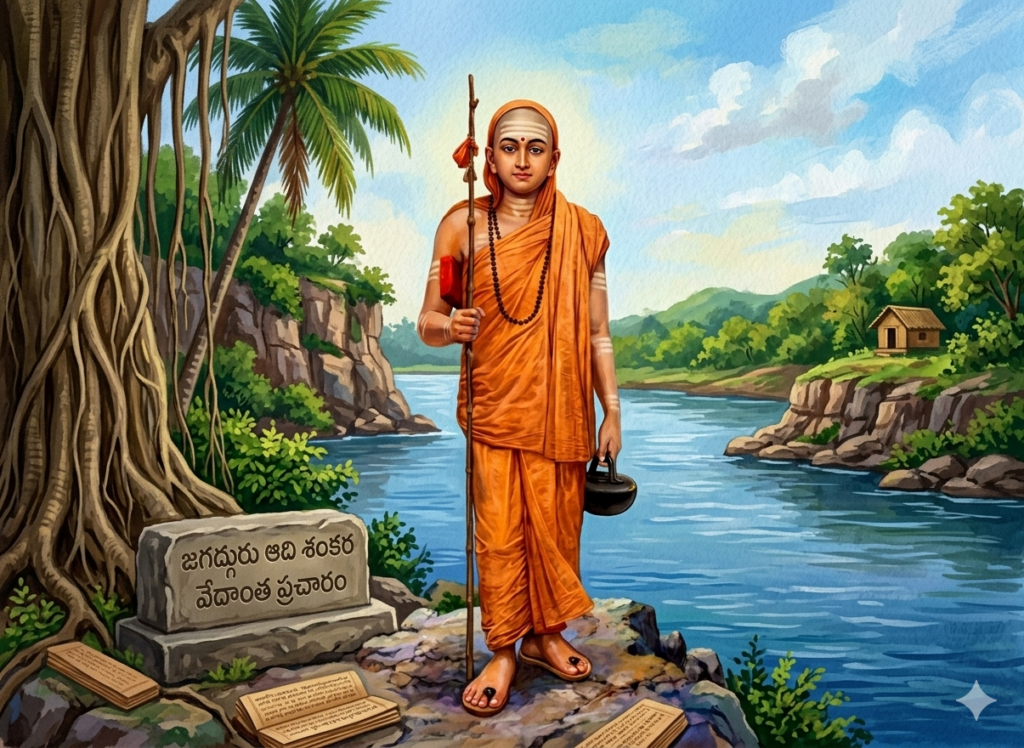
The philosophical architecture of the Indian subcontinent was profoundly reshaped in the 8th century by Jagadguru Adi Sankaracharya. His teachings offer a rare, masterful synthesis of rigorous logic and sublime devotion. Here, we map the sacred canon of his lineage, exploring how he utilized the Sanskrit language to bridge the gap between the finite human experience and the infinite reality of Brahman.
I. The Core Doctrine: Advaita Vedanta
At the heart of Sankaracharya’s teachings is the doctrine of Advaita (Non-duality). His primary objective was the systematic removal of Avidya (ignorance) through the application of Jnana (transformative knowledge).
In his foundational commentaries, he establishes the ultimate, uncompromising reality of existence in half a verse:
“ब्रह्म सत्यं जगन्मिथ्या जीवो ब्रह्मैव नापरः”
(Brahma satyam jagan-mithyā jīvo brahmaiva nāparaḥ)
Meaning: Brahman is the absolute substrate; the perceived world is a relative projection (Maya), and the individual consciousness is essentially identical to the Universal.
II. The Three Pillars of Wisdom
Adi Sankaracharya’s vast body of work is traditionally categorized into three distinct functional groups. Each serves a specific stage of a spiritual seeker’s journey, catering to the intellect, the need for scriptural grounding, and the heart’s capacity for devotion.
1. The Foundation: Prakarana Granthas (Introductory Treatises)
Before engaging with complex scriptures, a seeker must develop a disciplined mind and sharp intellect. These foundational texts provide the necessary definitions and logical frameworks.
Vivekachudamani (The Crest-Jewel of Discrimination):
A comprehensive manual for the intellect. It teaches the seeker to meticulously distinguish the Atman (the eternal witness) from the Anatman (the transient non-self).
Upadesasahasri:
A pedagogical masterpiece employing the method of Adhyaropa-Apavada—the process of first superimposing qualities onto the Divine for the sake of understanding, and then systematically negating them to arrive at the attributeless Truth.
2. The Authority: Bhashyas (Exegetical Commentaries)
To revive the core teachings of the Vedas, Sankaracharya wrote profound commentaries on the Prasthana Trayi (the three sources of authority): the Upanishads, the Brahma Sutras, and the Bhagavad Gita.
Bhagavad Gita Bhashyam: This commentary transformed the Gita from a regional dialogue into a universal manual for liberation. Sankaracharya emphasizes a crucial distinction: while Karma (action) purifies and prepares the mind, only Jnana (knowledge) ultimately results in Moksha (liberation).
3. The Integration: Stotrams (Devotional & Aesthetic Hymns)
Lest the philosophy of Non-duality be viewed as purely cerebral and detached, Sankaracharya composed hymns of unparalleled poetic beauty, proving that the highest knowledge and the deepest devotion are one.
Bhaja Govindam: A visceral, urgent reminder of the transience of material life and the necessity of spiritual focus.
“मा कुरु धनजनयौवनगर्वं हरति निमेषात्कालः सर्वम्”
(Mā kuru dhana-jana-yauvana-garvaṃ harati nimeṣāt-kālaḥ sarvam)
Meaning: Do not pride yourself on wealth, followers, or youth; Time steals them all in the blink of an eye.
Soundarya Lahari: A sophisticated exploration of the Shakti principle, illustrating that the non-dual reality is also the dynamic source of all cosmic beauty and creative energy.
III. The Intellectual Hierarchy of the Visual Record
The specific arrangement of the literature mirrors the ascending path of traditional inquiry. The textual hierarchy acts as a ladder from foundational reasoning to unified realization:
| Level of Inquiry | Sanskrit Classification | Functional Purpose | Representative Work Example |
|---|---|---|---|
| Foundational Logic | Tarka / Vichara | Cultivating discernment and definitions | Vivekachudamani |
| Direct Experience | Anubhava | Internalizing the non-dual state | Advaita Anubhuti |
| Scriptural Authority | Shastra / Bhashya | Anchoring insight in Vedic revelation | Bhagavadgita Bhashyam |
| Devotional Integration | Bhakti / Upasana | Merging intellect with sublime surrender | Sivananda Lahari |
IV. The Ultimate Realization
Adi Sankaracharya’s legacy is not a collection of static documents; it is a dynamic, living system of thought designed to collapse the perceived distance between the seeker and the sought. By asserting that the “Self” in every being is one and the same, his work provides the ultimate metaphysical foundation for universal empathy.
The quintessence of his teaching—and the final destination of the seeker’s journey—remains captured in his profound realization of self-identity:
“चिदानन्दरूपः शिवोऽहम् शिवोऽहम्”
(Cidānanda-rūpaḥ śivo’ham śivo’ham)
Meaning: I am of the nature of pure Consciousness and Bliss. I am Shiva. I am Shiva.