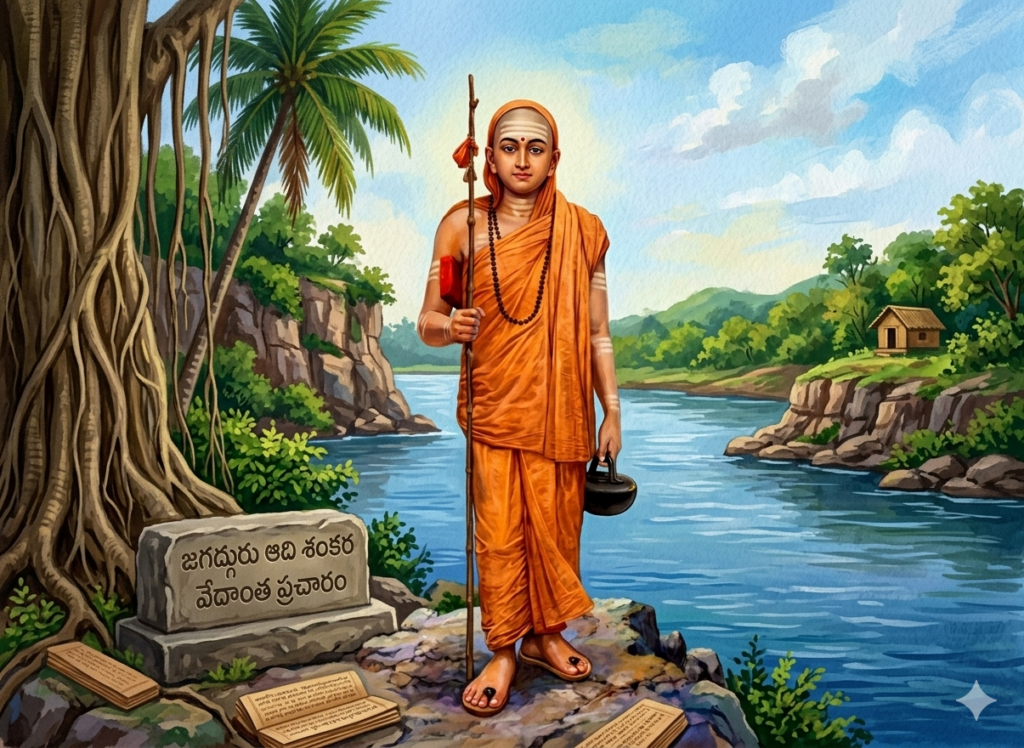
Peethams Established by
Sri Adi Sankaracharya
The 4 Amnaya Peethas which stand as living testaments to Adi Sankaracharya’s ultimate vision: a spiritually united world grounded in the singular, unshakeable truth of universal consciousness.
To ensure the enduring survival of Advaita Vedanta and to weave the diverse spiritual fabric of the Indian subcontinent into a unified whole, Jagadguru Adi Sankaracharya executed a masterstroke of spiritual and geographic vision. He established four primary monastic institutions, known as the Amnaya Peethams. Positioned strategically at the cardinal points of India, these centers were designed not merely as administrative hubs, but as living, breathing repositories of the four Vedas, ensuring an unbroken lineage of wisdom for millennia.
I. The Four Spiritual Centers of Enlightenment
The architecture of these four institutions forms the bedrock of the Dashanami Sampradaya (the order of ten spiritual names), guiding ascetics and householders alike to this day.
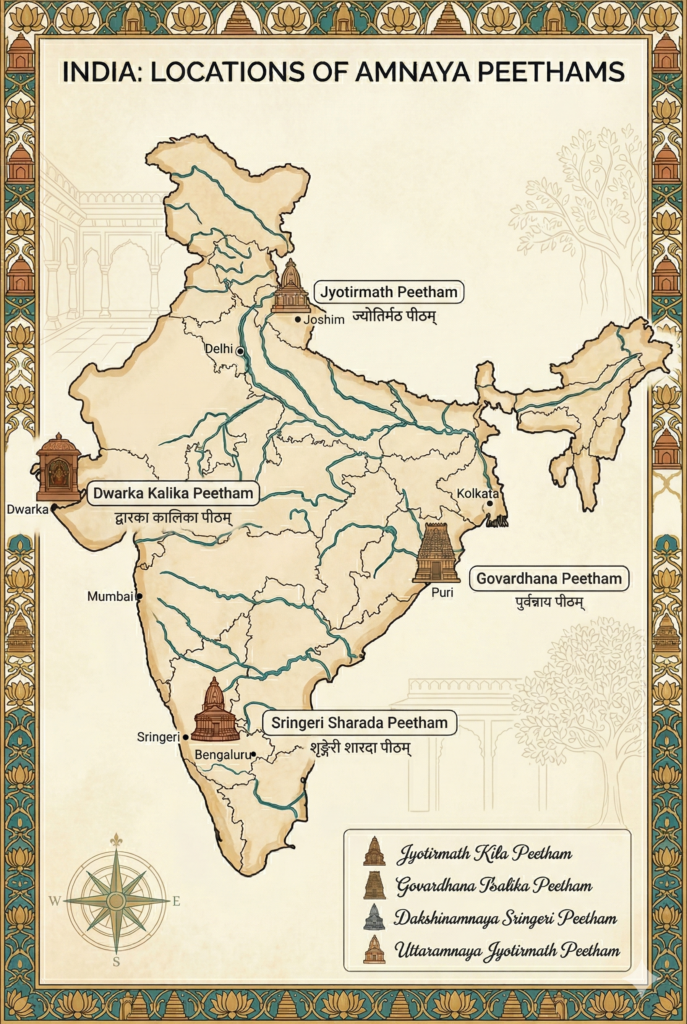
1. The Southern Seat: Dakshinamnaya Sri Sharada Peetham (Sringeri)
Nestled on the serene banks of the Tunga River in Karnataka, this is considered the first and most prominent of the Peethams. It is dedicated to the Goddess of Knowledge, Sri Sharada.
2. The Eastern Seat: Purvamnaya Sri Govardhana Peetham (Puri)
Located on the sacred eastern coastline in Odisha, the Govardhana Peetham holds the spiritual authority for the eastern region of the subcontinent, intimately connected to the Jagannath Temple.
3. The Western Seat: Pascimamnaya Sri Kalika Peetham (Dwarka)
Situated in the ancient, sacred city of Dwarka in Gujarat, the domain of Lord Krishna, this Peetham guards the western frontiers of Sanatana Dharma.
4. The Northern Seat: Uttaramnaya Sri Jyotir Peetham (Badrinath)
Located high in the majestic Himalayas in Uttarakhand, Jyotirmath (the Seat of Light) serves the northern regions and the countless ascetics wandering the sacred mountains.
II. The Sacred Geography and Strategic Vision
Adi Sankaracharya recognized that philosophical treatises alone could not sustain a spiritual revival without a resilient institutional framework. He conceptualized the Amnaya Peethams (Seats of Sacred Tradition) to safeguard the pristine teachings of the Shruti (Vedic revelations).
By placing these Mathas (monasteries) in the North, South, East, and West, he essentially mapped the sacred geography of India, creating a profound metaphysical boundary that united the subcontinent through a shared pursuit of ultimate truth. To each Peetham, he assigned a specific Veda, a profound Mahavakya (Great Contemplative Equation), and one of his four primary, enlightened disciples as the founding Acharya.
III. An Unbroken Lineage of Light
The establishment of the four Amnaya Peethams was not merely a historical event, but the ignition of an eternal flame. By anchoring the profound logic of Advaita Vedanta within these lasting institutions, Adi Sankaracharya ensured that the Parampara (the unbroken lineage of Master to Disciple) would survive the ravages of time and history.
Today, the reigning Sankaracharyas of these Peethams continue to serve as the spiritual compass for millions. They stand as living testaments to Adi Sankaracharya’s ultimate vision: a spiritually united world grounded in the singular, unshakeable truth of universal consciousness.